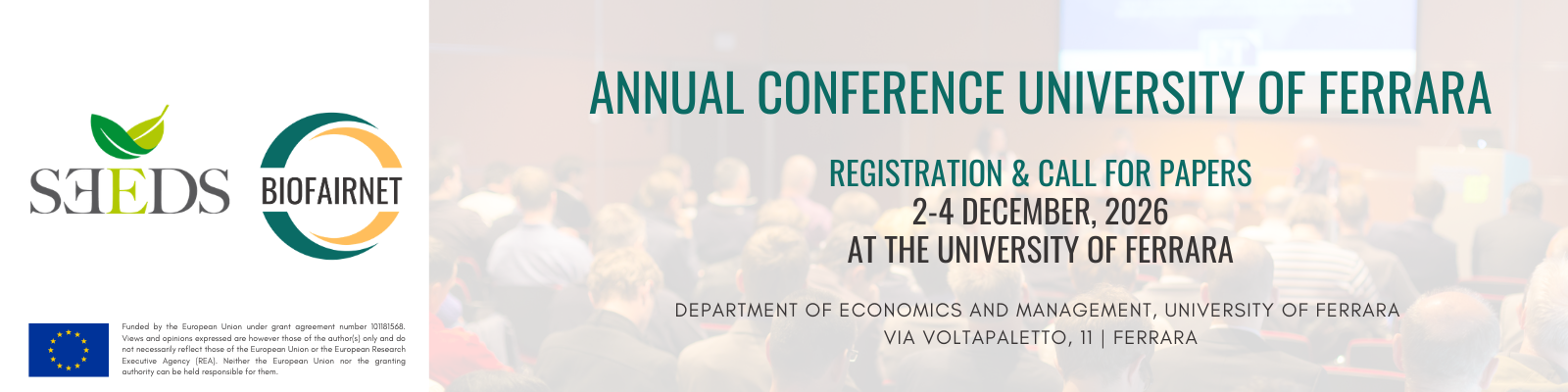
2 December 2026 | University of Ferrara
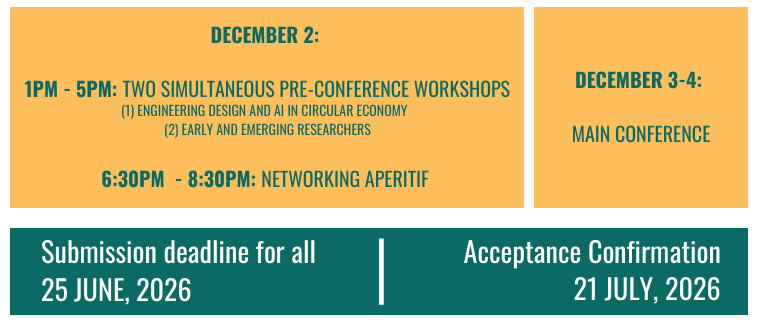
The SEEDS–BioFairNet Annual Conference 2026 will open on 2 December with a preconference afternoon dedicated to focused exchanges and early engagement among participants. Before the main sessions begin, this first day offers an opportunity to explore specific research areas, refine ongoing work, and connect with colleagues working across the socioeconomic and technological dimensions of circularity and the bioeconomy transition.
Participants are invited to join these workshops as an opportunity to engage early with the conference community, and explore emerging perspectives before the main programme begins. Both workshops are open to attendees wishing to participate in the discussions as well as to those who would like to submit an abstract and present their ongoing research.
Workshop for Early and Emerging Scholars
This workshop welcomes PhD candidates, postdoctoral fellows, and earlycareer academics working on sustainability, environmental economics, circular economy, and related fields. It offers a supportive environment for presenting ongoing research, receiving feedback from peers and senior scholars, and engaging in dialogue on emerging topics linked to the green transition, sustainable innovation, and environmental policy.
Themes include renewable energy and climate impacts, circular material flows, biobased substitution, cooperation within production chains, and the role of sharing models and product durability. Contributions may follow qualitative, quantitative, or mixedmethods approaches.
REGISTER HERE TO ATTEND (NONPRESENTING) OR TO SUBMIT YOUR ABSTRACT:

Workshop on Engineering Design and AI in Circular Economy
The workshop brings together researchers and practitioners working at the intersection of engineering design, artificial intelligence, and circular economy. It is intended for participants from engineering, computer science, sustainability studies, and related fields who are developing technological solutions for resource efficiency and circular production systems.
Topics include engineering design for sustainability, generative design and topology optimization, advanced and green manufacturing, digital twins and simulationdriven sustainability assessment, integration of engineering data with environmental and economic evaluation, and AIdriven process optimization. Contributions may include conceptual work, methodological developments, prototypes, and applied case studies.
For further information, participants may contact Dr. Tobias Rosnitschek (Tobias.Rosnitschek@uni-bayreuth.de).
REGISTER HERE TO ATTEND (NONPRESENTING) OR TO SUBMIT YOUR ABSTRACT:

About the Workshops
Both workshops will take place from 1PM to 5PM and form an integral part of the conference’s preevent activities. Participation is free of charge.
More details for those presenting, the workshops, and the aperitif will be shared with those who confirm attendance or/and have expressed interest via call for papers.